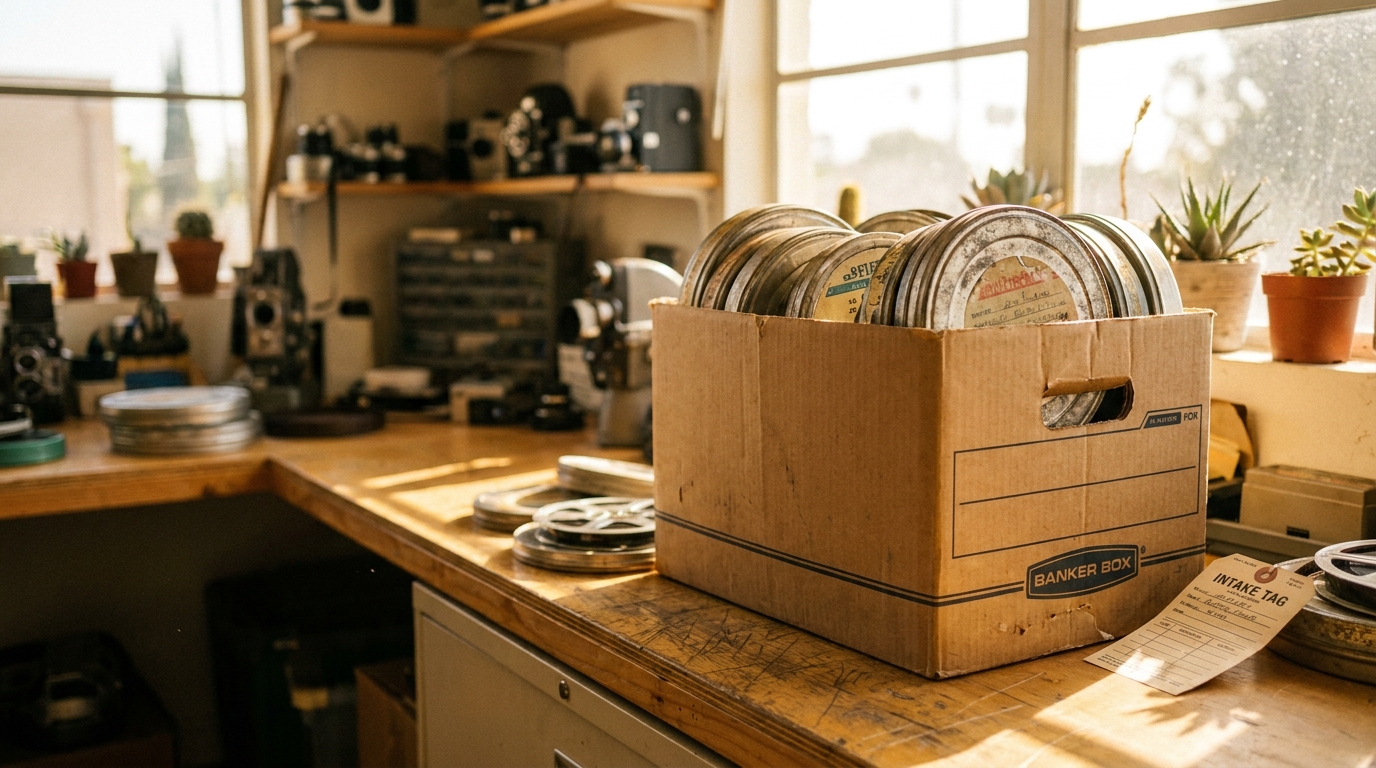
Call the lab in Orange, California first, then drive the box over. Bring every reel and tape, the original cans, boxes and sleeves, and any handwritten labels, because that handwriting is often the only surviving date record. What happens next: each item is logged by hand under a full chain of custody, inspected before anything runs, scanned frame by frame in the same building, then returned with your originals in the same shipment. What it costs: film is billed by the foot actually transferred rather than by a flat per-reel fee, and a service minimum applies to any order. Current rates are on what film transfer costs.
- Phone the lab before you come so hours are confirmed and someone is free to log your items in properly.
- One container, everything in it, boxes and labels included.
- Footage, not reel count, sets the price. A 3 inch reel holds about 50 feet, a 7 inch about 400.
- Originals come home in the same shipment as your files. Always.
- More than 125,000 reels transferred without losing a single item.
Can I drop film off in person?
Yes, you can hand your film across the counter in person at the lab in Orange, California, and calling first is the only step that comes before it. That call confirms current hours, gets you the address and the right entrance, and makes sure someone is free to log your items in properly rather than between other jobs.
Where you are actually driving to
One building in the city of Orange, California, in Orange County, and the scanning happens in the same building you walked into. Drop-offs run on weekday business hours, roughly mid-morning to late afternoon, Monday through Friday, and precise hours shift with the workload. Call before you set off and you will get the exact street address, the cross-streets, the nearest freeway exit, the door to use and a confirmed time when someone is free at the counter. That same call is where footage, format and likely cost get sorted out before you spend petrol. Prefer to start in writing? Use the quote form and the address and directions come back with the reply.
If you live in Anaheim, Tustin, Santa Ana or Villa Park this is an errand you can run before lunch. From Long Beach, Riverside or northern San Diego County it is a longer drive, but it is still a drive rather than a shipment. There are no branches in Los Angeles, Riverside, San Bernardino or San Diego, and we will not pretend otherwise; where we are and who we serve maps how each surrounding county is handled. Walking in involves the fewest handoffs of any delivery method: your hands to ours, nothing in between.
What to bring
- Every reel and tape, including the ones you assume are blank.
- The original cans, boxes and sleeves. Handwriting on a lid is often the only surviving date record.
- Anything already spliced onto a big reel, left as-is. Do not try to break it apart.
- One container that closes. A banker’s box beats four grocery bags at the counter.
- A note of anything you want prioritised, plus name spellings you want on the files.
What you do not need: a format identification. You do not have to know whether it is Regular 8, Super 8 or 16mm. That is settled at inspection. If you want to read up first, the format-level detail lives on digitalfilmtransfer.com and, for 16mm, 16mmfilmtransfer.com.
What happens after you hand the box over
Intake: every item logged by hand and tracked under a full chain of custody from the moment it arrives. Inspection: condition assessed before anything runs, because damage found early is damage that does not get worse. Scanning: frame by frame, each frame captured as a separate image, on Motion Picture Academy grade equipment at true HD 1080p minimum and up to 2K.
Then return: MP4 files on a flash drive for orders under 256 GB, a hard drive above that, and your originals in the same shipment, as covered in the FAQ below. The full sequence is on How it works.
Nothing in that chain leaves the building. Every scan happens here, which is why the queue quoted at the counter is genuinely ours and why we can say where your material is on any given day.
Why inspection is the step that saves jobs
Inspection catches the reel a family had written off as blank and the can carrying the acetic smell of vinegar syndrome, and a reel that is degrading gets moved ahead of the stable ones in the queue. The step by step detail sits on How it works, which is why we ask you to bring even the reels you would otherwise bin.
What that looks like in practice: a box came in with eight 7 inch reels, and the smell was obvious the moment the lid came off the third can, sharp and sour like a bottle of vinegar opened under your nose. The lid was marked in ballpoint, 1968, and the outer few turns of that reel had gone stiff and slightly cupped, the edges curling away from the core the way acetate does once it starts breaking down. Wound in, past the first hundred feet or so, the film was still supple and the emulsion was intact. That reel went to the front of the queue ahead of the seven stable ones in the same box, was cleaned and handled gently through the gate, and the bulk of it scanned frame by frame with only the worst of the outer turns lost to shrinkage and warp. The seven that smelled of nothing waited their turn, because they could afford to. Nobody would have known which was which from the outside of the cans, and that is the whole argument for inspecting before anything runs.
What it costs, and why “ten reels” is not a price
Film is billed by the foot actually transferred, not by a flat per-reel fee. If a 400 foot reel is only half full, you pay for the film that is really there. That mechanic is why two people who each say they have “ten reels” can be quoted very different totals and both quotes be fair.
Compare labs on that mechanic rather than on a headline number. Many bill a flat fee per reel, which makes a 3 inch reel and a 7 inch reel one line item apiece when they are roughly eight times apart in footage. Ask which of the two any lab does, because that answer moves your total more than the rate does.
| Reel | Approx. footage | Effect on a per-foot quote |
|---|---|---|
| 3 inch reel | About 50 feet | The baseline footage a per-foot quote is built on |
| 7 inch reel | About 400 feet | Eight times the footage, so around eight times the film cost |
Most people underestimate their total footage by two times or more, so count reels by diameter before you call, not by how many boxes are on the shelf. Six 3 inch reels and two 7 inch reels is not eight reels, it is roughly 1,100 feet of film, and that is the number a per-foot quote is built on.
A service minimum applies to any order; if an order totals less than that minimum, a line item called “Minimum order adjustment” makes up the difference. Discs are priced per disc, with a different rate depending on whether the order is disc-only or includes a drive, and optional scene by scene color correction and grain reduction are quoted separately. Current rates for all of it live in one place, on what film transfer costs.
What dropping off actually saves
Not money, and we will not dress it up as a discount. It saves round-trip shipping on something that cannot be replaced, and it saves the insurance conversation nobody enjoys: what is a box of family film worth, and what would a carrier pay if it vanished?
Turnaround: why there is no date at the counter
No exact completion date is promised, and the reason is honest. A reel that needs splicing or a tape that needs cleaning adds hours nobody can predict from an intake form. What you get instead is the current queue, quoted to you at the counter or on the phone in the week you call, because it moves with the workload and with how much splicing and cleaning the boxes ahead of yours turn out to need. We do not publish a fixed number of weeks here for the same reason we do not promise a completion date at intake: it would be stale by the time you read it. Ask on that first call and you will get the real figure for that week, and it is genuinely ours, because nothing is sent out.
Rush service is available at additional cost, quoted per order in the week you call. If you have a memorial, a birthday or an anniversary, say so on that first phone call rather than at pickup.
Legacy Digital has been in Orange since 2001, and Scott Foster, who founded it, still does the work himself. When you hand a box across the counter you are usually handing it to the person who will scan it. More about the lab.
FAQ
Will I get my original film back?
Yes. Originals are always returned in the same shipment as your files, and converting media does not harm it. More than 125,000 reels have been through this lab without a single item lost.
Can I drop off if I live in LA, Riverside, San Bernardino or San Diego?
Yes, and plenty do. There is one lab and it is in Orange. If the drive is not worth it, ship in instead: a short in-state hop, not a cross-country trip, and the box comes back with your originals. See where we are and who we serve.
Do I need an appointment to drop film off?
Not a formal appointment, but call first. That call confirms current hours, gives you the address and the right entrance, and makes sure someone is free at the counter to log your items in properly rather than between other jobs.
Do you take 8mm, 16mm and video tapes?
Yes, and you do not need to identify the format yourself. Bring the reels and tapes as they are, including anything already spliced onto a big reel, and whether it is Regular 8, Super 8 or 16mm is settled at inspection.
Next step
Call the lab in Orange, California to confirm hours and get the address, then bring the box. If you want to see how other people’s drop-offs went first, read the customer reviews, then get a free quote.